
Guides
IGI and GIA reports, and how to read them
A grading report is a letter from a laboratory about one diamond. It describes one diamond, nothing more.
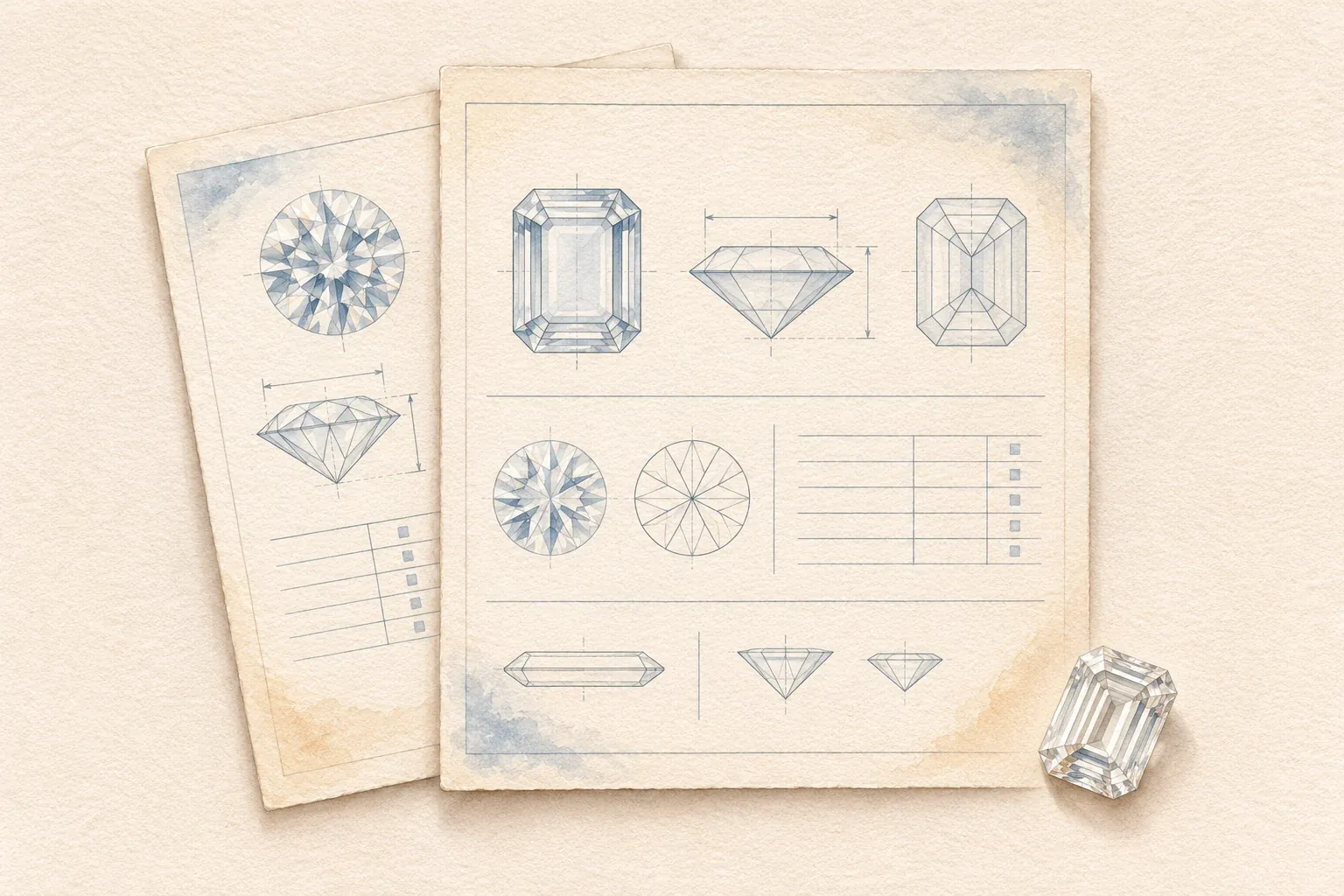
Two laboratories, one job
GIA is the Gemological Institute of America. It was founded in 1931 and gave the trade the four words most people now use: cut, color, clarity and carat. IGI is the International Gemological Institute, founded in 1975. Both are independent of the jeweler who shows you the stone. Neither one is OVOEU, and neither one sets the price of a commission.
Both laboratories grade natural diamonds and lab-grown diamonds. On a lab-grown report, the origin is stated. You should see, in plain language, that the diamond is laboratory-grown. If that sentence is missing, ask. A report that leaves origin to be inferred is not the standard OVOEU works to. The comparison between the two kinds of diamond is in Lab-grown and natural diamonds.
What you are actually reading
Carat is weight, not the width across the face of the stone. Color, on the familiar D to Z scale, describes how little body color the diamond shows, with D at the colorless end. Clarity describes inclusions inside the stone and blemishes on its surface, from a stone with nothing a skilled grader sees under magnification toward stones where inclusions are easier to notice. Cut, when a laboratory gives a cut grade, describes how the facets and proportions handle light.
Those four words are a vocabulary, not four contests you have to win. Every new OVOEU diamond is colorless, D to F, so a warm metal is a choice of tone, not a way to hide color. Every new OVOEU diamond is VVS, so clarity is settled before you choose a shape. See Our Standard.
Where the reports differ
For a round brilliant, a cut grade is a familiar line on the report, and it is worth reading. Fancy shapes, such as oval and emerald, are not always graded on the same cut scale from one laboratory to the next. Proportions, polish, symmetry and the measurements of length and width still appear, and they tell you more than a single adjective. Oval, emerald and round is about those outlines.
Two laboratories can look at one diamond and not print identical grades. That is a reason to look at the stone, not a reason to distrust every report. The paper and the diamond should agree in the ways that matter to you: the outline, the face-up color, and whether anything inside the stone bothers you when you see it. Your Concierge is there for that comparison. At the atelier you can hold the diamond. Virtually, you see certified stones live on video.
Growth method and treatment
A lab-grown report often names the growth method, HPHT or CVD, and it notes a treatment when the laboratory detects one. Those lines are worth reading with a person, not skimming as fine print. HPHT and CVD explains the two methods. A treatment is not a secret to be embarrassed about. It is a fact the report is supposed to carry, so you know the history of the color you are seeing.
Many diamonds also carry a laser inscription on the girdle, a thin line of characters that matches the report number. It is a way to pair the paper with the stone. Not every inscription is equally easy to see, and not every conversation needs to begin there. If you want to see it, ask. It is a small confirmation, not the beauty of the ring.
What arrives with an OVOEU ring
An OVOEU ring is set with a lab-grown diamond, and an independent IGI or GIA report is supplied with it. The house does not ask you to choose a laboratory as a matter of loyalty. The diamond and the design come first. The report documents the diamond you chose.
Nothing on the report is the quote for the ring. You receive that quote with the Technical Drawing, once the diamond and the design are known. Most commissions rest between $3,000 and $6,500, complete with the stone. The report will not tell you where inside that span a commission sits, because the span is about the whole piece: the diamond, the metal it is drawn in, and the hours of hand-finishing. The cost of a commission keeps those facts in one place.
Before we meet
A few questions.
Does OVOEU use IGI or GIA?
Either. An OVOEU ring arrives with an independent IGI or GIA report. The house does not treat one laboratory as the only acceptable one. Your Concierge reads the report that belongs to the diamond you are considering.
Is a report the same as a price?
No. The report describes the diamond. The quote for an OVOEU commission arrives with the Technical Drawing, and it covers the piece, not a line on a certificate.
Will two laboratories grade one diamond identically?
Not always. IGI and GIA are independent, and their wording is not a single shared scale for every shape. Compare the diamond in front of you with the report in your hand, rather than comparing two laboratories in the abstract.
Your Concierge
Begin with a conversation.
Nothing is decided in the first meeting. A Board is welcome, and never required.
Continue
Lab-grown and natural diamonds, plainly compared
How lab-grown and natural diamonds compare as a material, what a grading report shows, and why OVOEU works in lab-grown diamond only.
HPHT and CVD, two ways a diamond is grown
What HPHT and CVD mean on a lab-grown diamond report, how the two growth methods differ, and why the stone in front of you matters more.
Oval, emerald and round
How oval, emerald and round diamond outlines differ in light, proportion and presence on the hand, before you choose a setting.