Guides
Oval, emerald and round
The outline is the first thing people see. Oval, emerald and round are three familiar ones, and they do not behave like three sizes of the same idea.
Begin with the outline
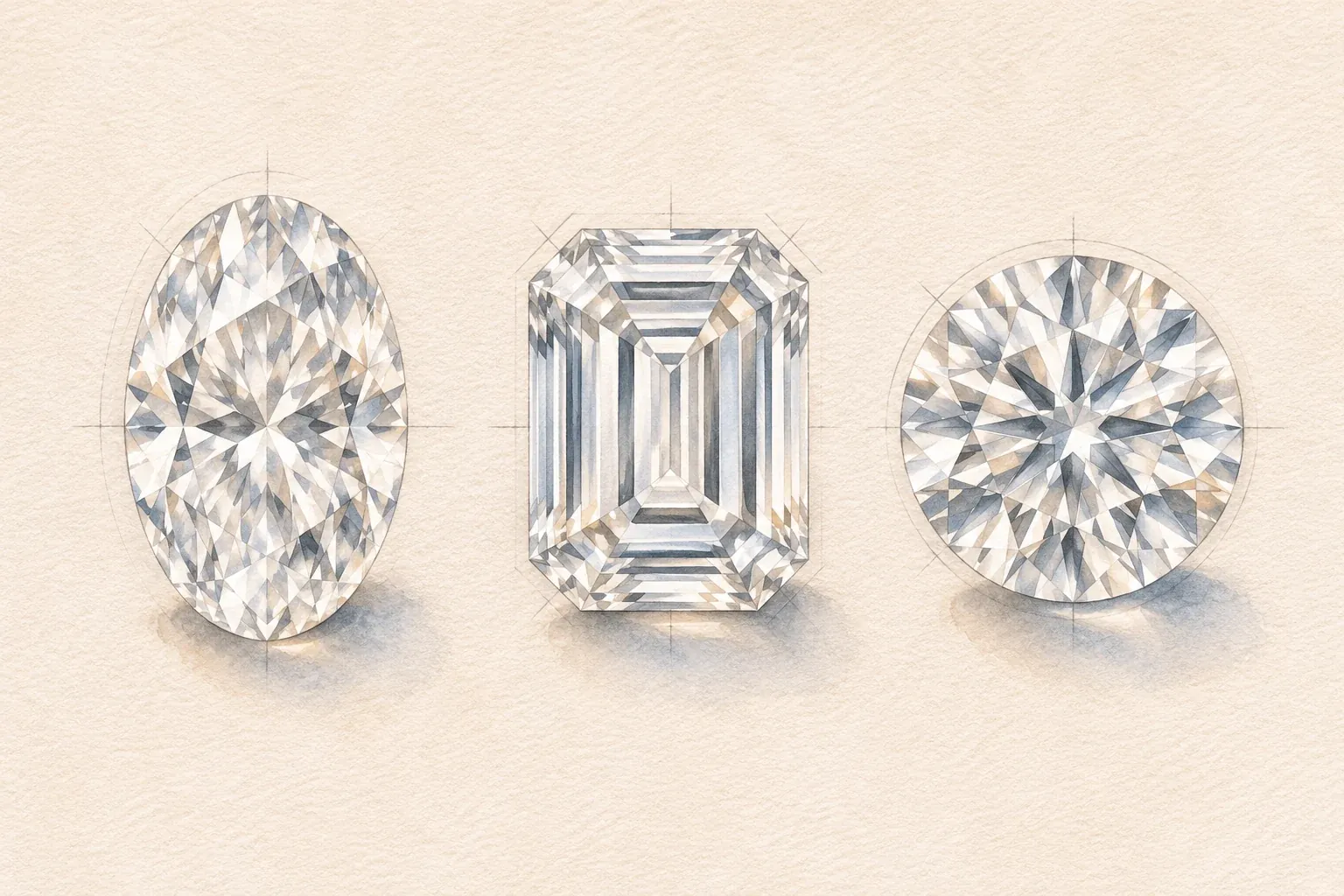
Before color grades and setting names, there is a silhouette. Round, oval and emerald are three silhouettes people recognize even if they have never read a report. OVOEU's studies include all three, and others. The studies are drawings of a direction, not finished rings waiting in a case. Our ring inspirations let you look at them that way: what catches your eye, with nothing yet to decide.
At the atelier you may see more than 100 diamonds in person, to compare shapes and carat sizes. That comparison is more useful than any paragraph, including this one. Arrive with a language. Let the diamonds revise it. Every stone in a new OVOEU ring is lab-grown, with an IGI or GIA report, in any of these outlines.
Round
A round brilliant is the circular outline, with the facet pattern most people mean when they say a diamond sparkles. Many facets break light into flashes. The shape is symmetrical, which makes it a calm center, and it asks the setting not to argue with it. Prongs leave the circle intact. A bezel turns the circle into a medallion. Both are drawn here.
Because a round puts its weight into a circle, it can look slightly smaller across the finger than an elongated shape of the same carat. Carat is weight. The face you see is a matter of diameter and of how high the stone sits. A cut grade, when the report gives one, describes how those proportions handle light. It is worth reading, and it is still not a substitute for looking. IGI and GIA reports explains what that line means and what it does not.
Oval
An oval is an elongated outline with soft curves. It lengthens the look of the finger, and it gives you a choice of direction: the long axis with the finger is the usual one, though a north-south oval is a different composition. The curves feel softer than the clipped corners of an emerald cut. People often describe an oval as having presence without the geometry of a step cut.
Some ovals show a bow-tie, a darker bow across the center, where facets return less light. A faint bow-tie is ordinary. A heavy one can bother you every time you look down. There is no ratio of length to width that removes the question. A longer oval and a rounder oval are both legitimate, and both should be looked at, tilted, and looked at again. Your Concierge would rather you reject a particular stone than a whole shape. The setting changes the bow-tie's company: a bezel frames it, prongs leave it open.
Emerald
An emerald cut is a rectangular step cut with clipped corners. Long, open facets act like a hall of mirrors. You see into the stone more than you see a field of flashes. Inclusions and body color, when they are there, have fewer facets to hide behind. That is the character of the shape, not a defect and not a demand that you buy the top of the clarity scale.
The outline can sit with the finger or across it. East-west is an orientation, not a different diamond. A long emerald cut in a low bezel is one of the quietest rings the house draws. A shorter one in prongs reads more as jewelry and less as architecture. Clarity is a conversation you have with the actual stone and its report. No minimum grade is published, because the stone is chosen with you.
Choosing among them
You are allowed to love two. A Design Session is 60 to 90 minutes of looking, not a vote you cast in advance. Bring a photograph of a hand you admire, or nothing. The proportion question, how large the stone feels beside the band, is easier with two diamonds on the table than with a carat number in mind. Size becomes a choice made together.
The outline also decides the wedding band. A round with a modest head often accepts a straight band. An elongated emerald or a low oval may want a band that follows the curve, or may not. Wedding bands explores that pairing. When you are ready to look, the atelier is in Oklahoma City, and the same hour can be virtual.
Before we meet
A few questions.
Does carat tell me which outline will look larger?
No. Carat is weight, not width. An elongated oval and a round of the same carat weight can cover the finger differently. Proportion and the setting change it again. Compare stones, not only numbers.
What is a bow-tie in an oval?
A bow-tie is a darker band across the center of some elongated stones, caused by the way the facets return light. It can be faint or obvious. The remedy is to look at the diamond, not to avoid the shape.
Are these the only shapes OVOEU draws?
No. The guide also includes pear, marquise and elongated old mine, among the studies. Oval, emerald and round are the three people most often compare first. You may like more than one.
Your Concierge
Begin with a conversation.
Nothing is decided in the first meeting. A Board is welcome, and never required.
Continue
Bezel and prong, two ways to hold a diamond
How a bezel setting and a prong setting each change the outline, the feel on the hand, and the way a wedding band sits beside an engagement ring.
IGI and GIA reports, and how to read them
What IGI and GIA diamond reports each record, how to read one without turning it into a score, and what arrives with an OVOEU ring.
Lab-grown and natural diamonds, plainly compared
How lab-grown and natural diamonds compare as a material, what a grading report shows, and why OVOEU works in lab-grown diamond only.